The Collins family had owned their lakeside cabin for more than fifteen years. Their dock, old but sturdy, sat in the same quiet cove season after season. But early this summer, something changed.
The dock was rising.
At first it was subtle—a slight tilt upward at the outer edge. They assumed the wood had swelled from humidity or that one of the support posts needed replacing. But within a week, the entire platform seemed to sit a few inches higher above the water than it ever had before.
The lake level hadn’t changed.
Their neighbors’ docks looked the same as always.
Only theirs was lifting.
One morning, while checking the waterline, Mr. Collins leaned over the edge and noticed tiny air bubbles rising from directly beneath one of the support beams. The pattern wasn’t random—it was steady, almost rhythmic.
Concerned about structural damage, the family hired a diver to inspect the underside of the dock.
The diver resurfaced almost immediately, stunned.
Beneath the dock, wedged between two rock shelves, was a large metal plate covered in silt. It didn’t belong to the dock’s construction, and it wasn’t part of any known lake infrastructure.
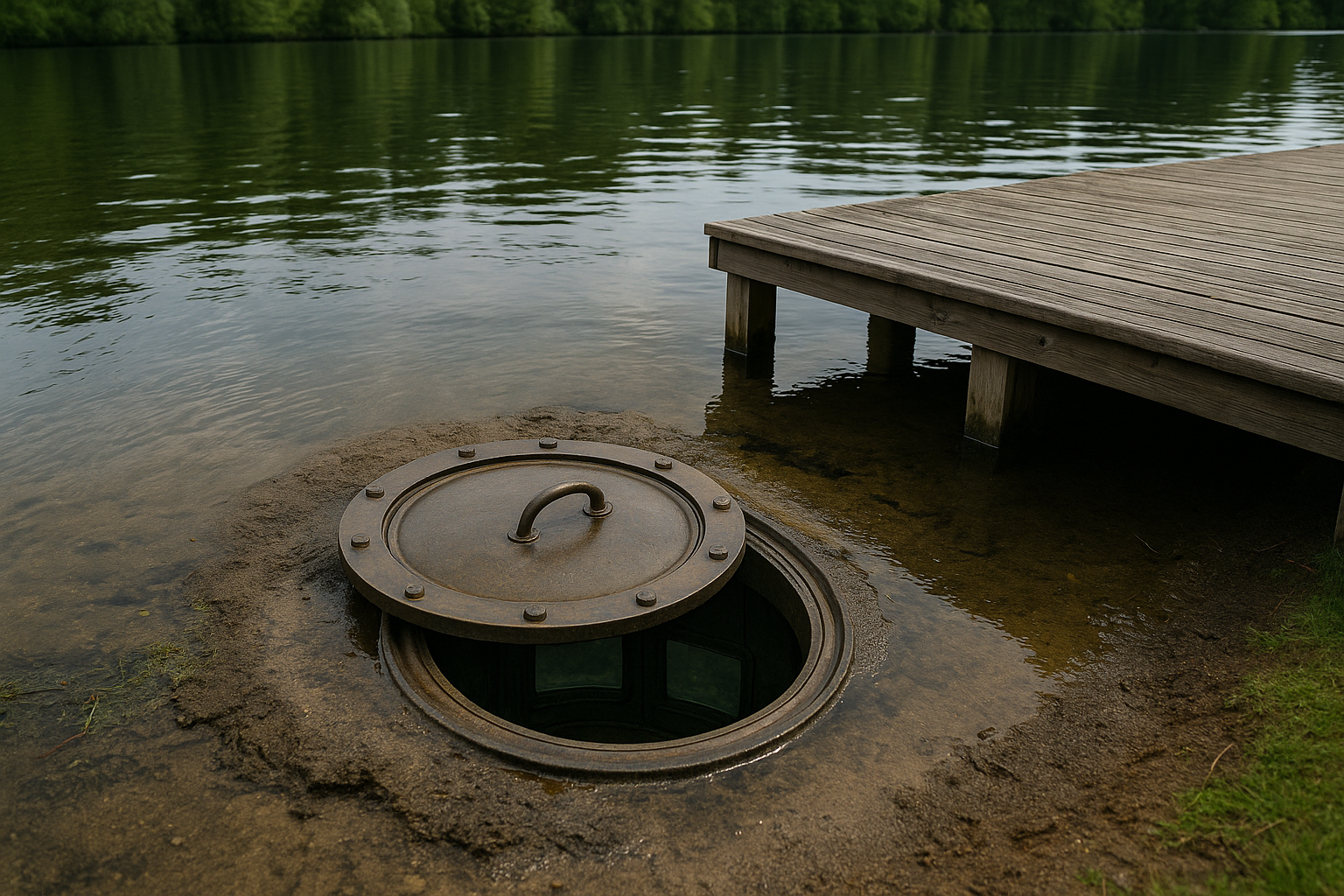
After carefully clearing away decades of sediment, the diver revealed a circular hatch embedded in the lakebed. The dock had been rising because the hatch had slowly shifted upward over time, pushing against one of the support posts.
The Collins family contacted local authorities, and soon a small research team arrived to investigate. With specialized tools, they managed to unseal the hatch and lift it open, revealing a water-filled shaft descending into a man-made chamber below the lakebed.
When the chamber was drained and accessed, researchers found a fully intact underwater observation room built sometime in the late 1960s. The walls were reinforced concrete, and large thick-glass viewing panels faced outward into the lake. On the steel desk inside were yellowed logbooks, waterproof field notes, and a set of early aquatic-monitoring instruments.
According to documents found inside, the chamber had been part of a small, privately funded project to study freshwater ecosystems long before modern environmental research became common. The project was quietly abandoned due to funding issues, and the chamber—accessible only through the lakebed hatch—was sealed and forgotten.
Over the decades, shifting sediment and natural water pressure worked the hatch loose just enough to affect the Collins’ dock above it.
When biologists later reviewed the records, they called the find a rare and invaluable snapshot of early freshwater-research methods, preserved almost exactly as they were the day the chamber was sealed.
The Collins family chose to keep the hatch visible from their dock, saying it reminds them that even a peaceful lake can hide a history deeper than the water itself.